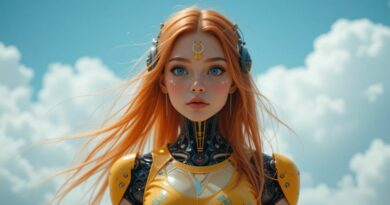
How AI-Generated Music Is Quietly Infiltrating Your Playlists
A new breed of AI-generated acts is attracting large numbers of streams, and some human musicians worry about being drowned out. Here’s how artificial intelligence is reshaping the music industry.
The morning commute playlist starts with a familiar indie favourite, transitions into something that feels authentically vintage, then shifts to what sounds like a lost track from the 1970s psychedelic revival. But something’s not quite right about that third song. The production is too polished for lo-fi, the lyrics too perfectly crafted for spontaneity, and the band behind it? They might not exist at all.
Welcome to the age of AI-generated music infiltration, where algorithms don’t just recommend songs—they create them, complete with fictional band members, fabricated backstories, and carefully curated aesthetic profiles. The phenomenon drew wide attention in mid-2025 with The Velvet Sundown, a mysterious psychedelic rock act that amassed over 500,000 monthly Spotify listeners in a matter of weeks, despite having no verifiable online presence beyond their streaming profiles.
Update (10 November 2026): Much has been confirmed since this article was first written. The Velvet Sundown revised its Spotify bio to describe itself as “a synthetic music project guided by human creative direction, and composed, voiced, and visualized with the support of artificial intelligence”, according to Rolling Stone. The scale has also grown: streaming service Deezer reported in July 2026 that it was receiving nearly 90,000 fully AI-generated tracks a day, passing half of its new uploads in June 2026, although such tracks accounted for only 1% to 3% of streams on the platform.
The Anatomy of a Digital Mirage
The Velvet Sundown is one of the best-known examples of an AI music project. Their original Spotify biography read like purple prose generated by an overzealous chatbot: “The Velvet Sundown don’t just play music — they conjure worlds. Somewhere between the ghost of Laurel Canyon and the echo of a Berlin warehouse, this four-piece band bends time, fusing 1970s psychedelic textures with cinematic alt-pop and dreamy analog soul.”
The band’s supposed members—”mellotron sorcerer” Gabe Farrow, “free-spirited percussionist” Orion “Rio” Del Mar, “synth alchemist” Milo Rains, and guitarist Lennie West—were found nowhere on the internet beyond this constructed mythology, with no concert footage or interviews, as observers noted at the time.
Their tracks were reported to feature in dozens of playlists and in some users’ Discover Weekly recommendations, which helped them gain listeners.
The Economics of Artificial Artistry
This isn’t merely a technological curiosity; it is also a business model with implications for working musicians. In 2024 the US Department of Justice charged musician Michael Smith in what it described as a case of music streaming fraud aided by artificial intelligence, alleging a scheme over several years that used AI-generated songs and automated accounts to collect fraudulent streaming royalties. The case shows how AI can be used to manipulate streaming.
The mathematics are stark. If an AI system can generate hundreds of songs daily at virtually no cost, whilst real musicians spend months crafting a single album, the economic dynamics shift dramatically. Each stream that flows to an AI-generated track represents revenue diverted from human artists who depend on streaming income to survive.
The phenomenon extends beyond individual bad actors. At one point, The Devil Inside, an act with approximately 700,000 monthly listeners and a track with 1.6 million streams, was reported to have achieved Spotify verification, and its creator has since admitted to using AI. Cases like this challenge streaming platforms’ ability to maintain the integrity of their catalogues.
The Uncanny Valley of Sound
What makes AI-generated music hard to spot is its increasing sophistication. Early artificial compositions were easily identifiable—stilted melodies, unnatural vocal inflections, and production that felt mechanical. Today’s AI music generators, particularly tools like Suno and Udio, produce tracks that inhabit an uncanny valley of authenticity.
The Velvet Sundown’s country-tinged psychedelic rock, for instance, demonstrates remarkable genre fluency. The tracks imitate the tape saturation and analogue warmth that listeners associate with vintage recordings.
Some listeners claim to hear tell-tale signs, such as vocal phrases that repeat with unnatural precision, but these judgements are subjective, and detection tools are still imperfect.
Platform Proliferation and Detection Challenges
The infiltration extends across multiple streaming services, each grappling with the challenge of identifying and managing AI-generated content. Spotify, Apple Music, YouTube Music, and others face a technological arms race where detection systems must evolve as quickly as generation capabilities.
The scale is large. Deezer, which runs an AI-detection tool, reported in April 2026 that it was receiving almost 75,000 fully AI-generated tracks a day, around 44% of its daily uploads, up from 10,000 a day little over a year earlier. (The figures are for a single platform.) The challenge lies not just in identifying AI-generated content, but in determining intent—is this artistic experimentation, commercial fraud, or something in between?
Some platforms have begun implementing labelling requirements for AI-generated content, but enforcement remains inconsistent. The lack of clear labelling has intensified debates about whether streaming services should be required to identify AI-generated songs, particularly when they achieve viral success.
The Human Cost
Behind the technological fascination lies a human story of displacement and devaluation. Some independent musicians say they fear being crowded out as playlists fill with AI-generated content that mimics their style at a fraction of the cost, though solid data on the effect on individual artists is limited. The democratising promise of streaming platforms—that anyone with talent could find an audience—becomes hollow when “anyone” includes algorithms.
The psychological impact on artists is a concern. Musicians who have spent years developing their craft find themselves competing against systems that can generate stylistically similar content in minutes. The unique human experiences, emotions, and perspectives that traditionally drove musical creation become commoditised and artificially replicated.
Regulatory Responses and Industry Adaptation
The music industry’s response has been fragmented but increasingly urgent. Trade organisations are lobbying for clearer regulations around AI-generated content, whilst some labels are embracing the technology as a creative tool rather than viewing it as a threat.
The distinction between AI-assisted and AI-generated music has become crucial. Many artists now use AI tools for inspiration, arrangement, or production enhancement, blurring the lines between human and artificial creativity. The challenge lies in maintaining space for genuine human artistry whilst accommodating technological innovation.
Some proposed solutions include mandatory disclosure requirements, separate charting systems for AI-generated content, and revenue-sharing models that account for the reduced production costs of artificial music. However, implementation remains complex, particularly given the global nature of streaming platforms and varying regulatory environments.
The Future Soundscape
As AI music generation becomes more sophisticated, the fundamental question evolves from “Can we detect it” to “Does it matter” If AI-generated music provides genuine listening pleasure, some argue that its artificial origins become irrelevant. Others contend that music’s value lies precisely in its human origin—the shared experience of emotion, struggle, and creativity that connects artist to listener.
The Velvet Sundown phenomenon suggests AI-generated music is becoming a significant presence, though so far it mostly imitates existing styles. Whether this represents evolution or invasion depends largely on how the industry chooses to adapt.
Conclusion: Navigating the New Musical Reality
The infiltration of AI-generated music into mainstream streaming platforms is more than a technological curiosity; it may change how music is created, distributed and valued. As algorithms become increasingly sophisticated at mimicking human creativity, the music industry faces unprecedented challenges in maintaining the integrity of artistic expression whilst embracing beneficial innovations.
The story of The Velvet Sundown serves as a cautionary tale about the ease with which artificial content can masquerade as authentic artistry. Yet it also highlights the capabilities of AI systems to create listenable music, raising questions about the nature of creativity.
As listeners, we face the choice of whether to care about the human origins of our musical experiences or to embrace a future where the source matters less than the sound. As an industry, music must grapple with protecting the livelihoods of human artists whilst allowing space for technological innovation.
The ghost in the machine isn’t just generating music—it’s forcing us to examine what we truly value in artistic expression. The answer will shape not just the future of music, but our understanding of creativity, authenticity, and human connection in an increasingly artificial world.
The conversation around AI-generated music continues to evolve rapidly.
We’d love your questions or comments on today’s topic!
For more articles like this one, click here.
Thought for the day:
“It’s so difficult to describe depression to someone who’s never been there because it’s not sadness.” J.K. Rowling