WebRTC Data Channels: The Future of Real-Time Communication
For most people, WebRTC is synonymous with video calls. Yet the technology goes far beyond that — it also includes a way to send arbitrary data directly between browsers.
Thanks to WebRTC data channels, developers can build encrypted, low-latency, peer-to-peer applications for everything from file sharing to live collaboration. A signalling server is still needed to set up each connection, and a TURN relay is used when a direct path fails.
In an era where privacy, latency, and flexibility matter more than ever, WebRTC data channels are an increasingly useful tool for real-time communication.
What Exactly Is a WebRTC Data Channel?
While traditional VoIP and WebRTC focus on transmitting audio and video streams, a data channel allows arbitrary data to be sent directly between browsers or devices using the same encrypted connection.
In other words, you can use the same protocol that powers a browser call to send chat messages, gaming data, IoT telemetry, or even encrypted files — typically without routing the data through a central server.
How Data Channels Work
WebRTC data channels use a protocol called SCTP (Stream Control Transmission Protocol) on top of DTLS (Datagram Transport Layer Security). This combination ensures that data is both secure and reliable.
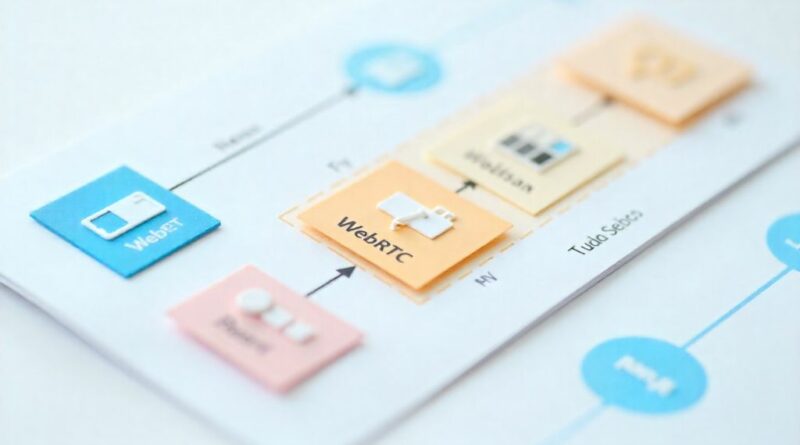
A simplified workflow looks like this:
- Signalling: Clients exchange session details via a signalling mechanism (like SIP or WebSocket).
- DTLS Handshake: Encryption keys are negotiated.
- SCTP Transmission: The secure channel carries structured or unstructured data with built-in congestion control and delivery guarantees.
👉 IETF RFC 8831 – WebRTC Data Channels
Real-World Use Cases
WebRTC data channels are more than a technical curiosity, and are used in a range of applications.
1. Real-Time Collaboration
Collaboration tools depend on near-instant updates between users. Most mainstream platforms use WebSockets or HTTP through central servers for this, but data channels offer a peer-to-peer alternative for some collaborative and file-sharing applications.
2. Multiplayer Gaming
In online games, milliseconds matter. Some developers use WebRTC data channels to send player inputs and game state updates directly between browsers, which can reduce the load on game servers.
3. IoT and Edge Computing
Because WebRTC can function over peer-to-peer connections, IoT devices can in principle communicate directly without cloud intermediaries, which can improve latency, resilience, and data privacy.
4. Secure File Sharing
WebRTC allows encrypted file transfer directly between users’ browsers. Files need not be uploaded to or stored on a server; the transfer happens over a temporary encrypted session between the endpoints.
Why It Matters for Developers
Traditional APIs often rely on WebSocket or HTTP, which depend on central servers for routing. WebRTC data channels, however, allow peer-to-peer data flow, which can reduce server costs and keep data off third-party servers.
For instance, a company can build a browser-based file exchange app that:
- Does not store files on a remote server
- Connects browser to browser once signalling completes
- Encrypts every packet automatically through DTLS
For some use cases that can be faster and more private than server-based alternatives, though it adds NAT traversal and reliability work.
👉 MDN WebRTC DataChannel Documentation
How WebRTC Data Channels Support SIP and PBX Evolution
Data channels also serve a bridging role in next-generation VoIP and PBX ecosystems.
They can carry signalling, configuration data, or session metadata between clients — creating hybrid solutions where voice and control data flow through the same encrypted channel.
For example, in a browser-based softphone, WebRTC handles voice while the data channel delivers live status updates, analytics, or call logs in real time.
Challenges Ahead
Despite their power, WebRTC data channels aren’t without limitations.
- NAT traversal can still be challenging, especially across enterprise firewalls.
- Scaling peer-to-peer models beyond a handful of participants is difficult, because a full mesh multiplies connections; larger groups need relay (TURN) or forwarding (SFU) servers.
- Debugging encryption-heavy traffic remains technically complex for developers.
However, open-source projects such as Janus Gateway and Pion WebRTC help address many of these obstacles.
The Future of Real-Time Communication
WebRTC data channels let users and devices exchange data directly and privately, with central servers needed mainly for setup and fallback.
From secure peer-to-peer communication to lightweight collaboration tools, this capability supports a growing set of browser applications.
Real-time web applications are no longer just about voice or video; data matters too.
For more articles like this, visit SoftpageCMS.