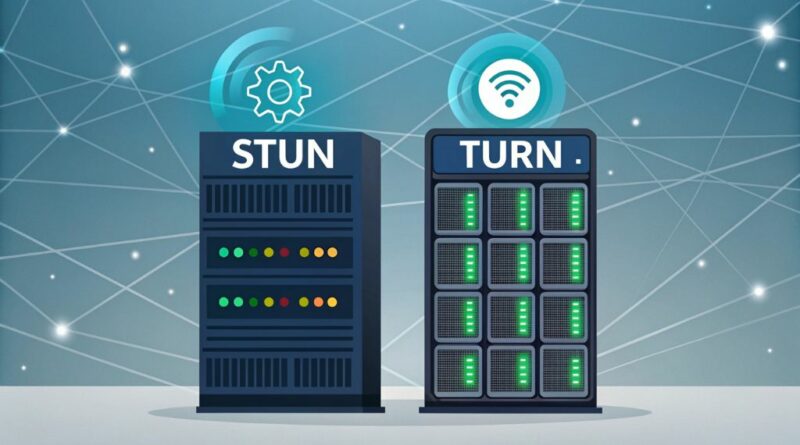
The Role of STUN and TURN Servers in WebRTC Connectivity
When users connect over WebRTC, the experience feels seamless — instant video, clear audio, and smooth data transfer between browsers. But beneath that simplicity lies a sophisticated negotiation process designed to handle one of the internet’s biggest headaches: firewalls and NATs (Network Address Translators).
This is where STUN and TURN servers come in — two crucial technologies that help WebRTC connections work across most network environments, including many restrictive ones.
Why STUN and TURN Matter
WebRTC’s biggest promise is peer-to-peer (P2P) communication — letting two devices exchange data directly without routing everything through a server.
However, real-world networks don’t always make that easy. Most devices sit behind NATs, which rewrite IP addresses for security reasons. This prevents external devices from knowing how to reach them directly.
That’s where STUN (Session Traversal Utilities for NAT) and TURN (Traversal Using Relays around NAT) step in. Together, they help peers find each other, even behind most firewalls.
👉 WebRTC.org STUN/TURN Overview
How STUN Works
A STUN server helps a device discover its public IP address and the type of NAT it’s behind.
When a WebRTC client starts a call, it sends a request to a STUN server on the public internet. The server replies with the device’s public IP and port. That information becomes part of the session’s ICE candidates — possible connection paths that peers can use to communicate directly.
This process is lightweight and efficient, which is why ICE tries direct paths, discovered with STUN, before falling back to a relay.
👉 IETF RFC 8489 – STUN Specification
When TURN Becomes Necessary
Sometimes, a direct P2P connection just isn’t possible. Corporate firewalls or symmetric NATs can block inbound connections entirely.
In those cases, WebRTC automatically falls back to TURN, a relay mechanism.
A TURN server sits on the open internet and relays traffic between peers when they can’t connect directly. While this adds latency and bandwidth cost for the operator, it means the connection can still succeed when no direct path exists.
In short:
- STUN-discovered direct paths are preferred (direct, fast).
- TURN is the fallback (indirect but far more likely to work).
👉 IETF RFC 8656 – TURN Specification
How ICE Brings It All Together
STUN and TURN are part of a broader framework called ICE (Interactive Connectivity Establishment). ICE collects candidate addresses from each peer, prioritises them, and tests them in real time to find the fastest, most stable route.
This negotiation happens automatically every time a WebRTC session begins, typically completing in well under a few seconds.
The result is encrypted, real-time connectivity between browsers across the great majority of network environments.
Security and Privacy Considerations
While TURN servers relay media traffic, they do not hold the DTLS-SRTP keys, so they cannot decrypt the media. They can still see metadata such as IP addresses and traffic volumes.
Administrators should still deploy STUN and TURN servers using TLS and authenticated access to prevent unauthorised use.
Modern open-source implementations like Coturn are widely used to run relay infrastructure in production, though they need careful configuration to be secure and scalable.
STUN, TURN, and Real-World Deployment
Here’s how most WebRTC-based systems handle NAT traversal today:
- Attempt STUN first for a direct peer-to-peer link.
- If that fails, fallback to TURN using the same ICE framework.
- Encrypt all data using DTLS-SRTP between the two peers.
- Monitor metrics (latency, packet loss) for quality assurance.
This layered approach is why users can make smooth, secure video calls through browser-based softphones or embedded communication apps — even in locked-down office networks.
Beyond Browsers: STUN/TURN in PBX and SIP Systems
Although best known for powering WebRTC, STUN and TURN have applications across SIP, PBX, and VoIP ecosystems.
Cloud-based PBX providers often use these same techniques to improve call reliability for remote users or mobile devices operating behind routers.
As more businesses migrate to hybrid WebRTC–SIP infrastructures, STUN and TURN remain vital to ensuring universal reachability.
Conclusion
Without STUN and TURN servers, WebRTC connections would fail on many home, mobile and corporate networks.
These protocols quietly handle the hardest part of internet communication: making two devices talk directly in a world of private networks and security boundaries.
They may be invisible to users, but they are essential to real-time voice, video, and data communication.
For more articles like this, visit SoftpageCMS.