
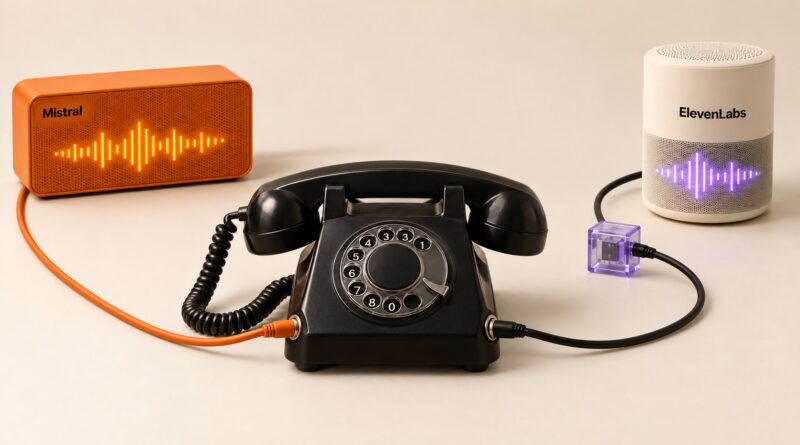
Mistral and ElevenLabs Launched Voice Agents on the Same Day. They Connect to Calls Very Differently.
On 20 October, Mistral and ElevenLabs both released new real-time voice models built for AI agents that hold spoken conversations. Mistral launched Voxtral 3, a full voice-agent kit priced from $0.04 a minute. ElevenLabs launched Eleven Realtime, a pair of speech-to-speech models whose reasoning scores come from an independent evaluator.
Most of the coverage so far has compared benchmark scores. The more practical difference between the two is how each one connects to an actual call. That decides whether a model can answer a phone line, run in a browser, or only talk to your own server.
What Mistral launched with Voxtral 3
According to Mistral’s announcement, Voxtral 3 is a family of speech models plus a voice-agent SDK. The SDK handles listening, reasoning and speaking as one streaming pipeline, and Mistral says it is built on the open-source LiveKit framework. Mistral prices the components separately:
- Voxtral Small Transcribe 3 (highest-accuracy transcription): $0.004 a minute
- Voxtral Mini Transcribe 3 (batch transcription): $0.0035 a minute
- Voxtral Mini Transcribe Realtime 3 (live transcription, under 500 ms): $0.008 a minute
- Voxtral Speech 3 (text to speech, 35+ languages): $13 per million characters
- The complete voice agent: $0.04 a minute with Mistral Small 4 doing the reasoning, or $0.08 a minute with a larger model
Mistral says each conversational turn completes in under one second. It offers the service through European, US and global endpoints, and organisations can arrange to run the full stack on their own infrastructure through Mistral’s team.
One correction to some early reports: at least one has put Voxtral 3 at about $0.001 a minute. That matches the starting API price of the original Voxtral models from July 2025, not anything in the Voxtral 3 price list. The cheapest Voxtral 3 component costs $0.0035 a minute, and the full agent $0.04.
What ElevenLabs launched
Eleven Realtime comes in two versions. Eleven Realtime v1 Max is aimed at reasoning and tool use, and v1 Mini at low-cost, fast conversation. Both are speech-to-speech models, so audio goes in and audio comes out without a separate transcription step. Both support more than 90 languages and any of the 17,000+ voices in the ElevenLabs library.
ElevenLabs says Max starts speaking after 0.57 seconds on average and Mini after 0.62 seconds. Artificial Analysis, an independent evaluator, measured the benchmark results:
- Big Bench Audio (spoken reasoning): Max 98.8%, Mini 75.9%
- Tool-use success: Max 87.1%, Mini 60.3%
- Full-Duplex-Bench (handling interruptions and turn-taking): Mini 95.8%, Max 94.1%
However, the announcement does not give a price.
The independent measurement matters. Several of the comparisons in Mistral’s announcement are its own internal evaluations. Neither set of numbers is wrong for that reason, but they are not the same kind of evidence.
The real difference: how each one connects to a call
A voice agent is only useful if audio can reach it, and there are three common ways to do that.
SIP is the signalling protocol most business phone systems use. A voice agent that speaks SIP can sit on an existing phone line or PBX much like another extension. It is the same protocol most of the softphones I compared in this year’s softphone round-up use to register with a phone system.
WebRTC is the real-time media technology built into every modern browser. It was designed for live audio. It sends media over UDP, copes with packet loss and jitter, and includes echo cancellation and network traversal. That makes it the natural choice when the caller is talking to an agent through a web page or app. (What a WebRTC softphone is covers the mechanics in more detail.)
WebSocket is a general-purpose connection that runs over TCP. It works well between servers. Over a poor connection, though, a lost packet holds up everything sent after it, which shows up as delay in a live conversation. It also provides none of the audio processing WebRTC does.
Where Voxtral 3 and Eleven Realtime part ways
The two launches differ here:
- Mistral says its agent “answers and places calls over SIP, runs in browsers and apps over WebRTC”. It supports phone lines and browsers directly.
- ElevenLabs says its Realtime API “connects over WebSocket only, so a WebRTC integration needs to move to WebSocket first.”
ElevenLabs has a reason for this. Eleven Realtime follows the specification of OpenAI’s Realtime API, and ElevenLabs says switching from OpenAI needs only a change of endpoint and model name. OpenAI’s own Realtime API documentation covers WebSocket connections alongside WebRTC and SIP, and recommends WebRTC for browser and mobile clients as the more robust option. So a team already running OpenAI’s API over WebSocket can try Eleven Realtime almost immediately. A team running it over WebRTC in the browser, or over SIP on a phone line, cannot. They would need to put their own server between the caller and ElevenLabs to relay the audio. ElevenLabs’ wider ElevenAgents platform does offer phone and web channels. The point is that the new Realtime API on its own does not.
Voice cloning from 30 minutes of audio
Mistral’s announcement includes Pro Voice, which it says can reproduce “a speaker’s distinctive character, emotional range, and speaking style across languages, using just 30 minutes of audio.” That is a capable feature for a company that wants its agent to sound like a real member of staff.
The announcement does not say how Mistral checks that the person whose voice it clones has agreed to it. It does not mention verification, watermarking or misuse controls. The only data controls it describes cover where Mistral processes audio and whether it keeps conversations. Mistral may well have these controls in its terms of service. Anyone planning to use Pro Voice should confirm them before uploading anyone’s voice. In my view, that should include the case where it is your own voice, because the resulting model can say things you never said.
By contrast, the Eleven Realtime announcement does not cover voice cloning at all, so there is nothing to compare on this point.
Is Voxtral 3 still open weights?
Mistral released the original Voxtral models in July 2025 under the Apache 2.0 licence, and anyone could download the weights from Hugging Face. The Voxtral 3 announcement does not say whether that applies to the new models. It describes self-deployment as something arranged with Mistral’s team. Developers who chose Voxtral because they could download it and run it freely should check the licence of each Voxtral 3 model before assuming the same terms.
Which one to look at
If your agent already runs on OpenAI’s Realtime API over WebSocket, Eleven Realtime is the easier one to test, and its reasoning scores come from an independent evaluator rather than the vendor. If your callers come in over a phone system or a browser, or if you need European hosting or your own infrastructure, Voxtral 3 is built for that without a relay server in the middle.
Both companies have now put a working voice agent within reach of a small team’s budget. The harder questions are the ones the announcements left open: what Eleven Realtime costs per minute, and what stops anyone cloning a voice that isn’t theirs.


