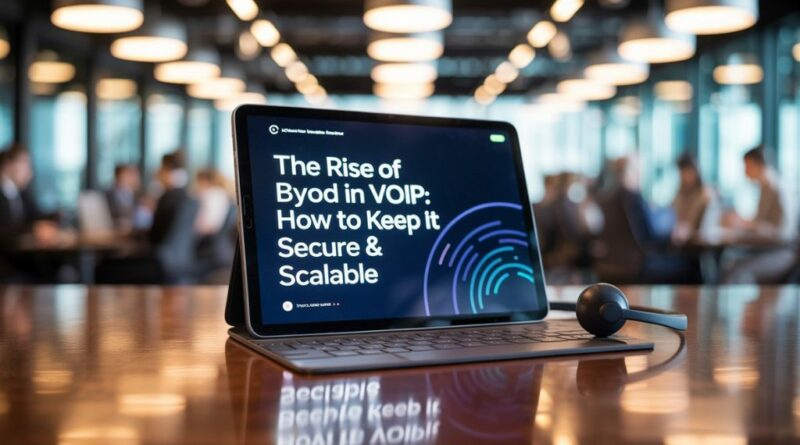
BYOD and VoIP: Keeping Staff Phones Secure and Manageable
Many businesses now let staff make work calls from their own laptops and mobile phones instead of issuing desk phones. This is usually called BYOD (bring your own device). It saves hardware costs and suits people who work from home, but it also means the business phone system is reachable from devices the IT team does not own or fully control. This article covers the specific risks BYOD brings to a VoIP phone system and the controls that deal with them.
How staff devices connect to a business phone system
A personal device becomes a business extension by running a softphone: either an installed app or a browser-based phone built on WebRTC. In both cases the softphone registers to the PBX with a SIP username and password, just as a desk phone does. Whatever is on that device, and whoever has access to it, therefore has access to that extension.
The risks specific to BYOD
- Credential exposure: SIP passwords stored in apps on personal devices can be extracted if the device is compromised, lost or shared with family members. A stolen SIP account can be used for toll fraud, which our overview of VoIP security threats describes.
- Untrusted networks: home and public Wi-Fi networks may be shared or monitored, so unencrypted signalling or audio can be captured.
- Leavers: when someone leaves the business, their softphone keeps working on their own device until the account is disabled or the password is changed.
- Data on the device: call history, contacts, voicemail and recordings may be stored on a device the business cannot wipe.
Controls that work
- Encrypt signalling and media. Require SIP over TLS (or WSS for browser phones) and SRTP, so calls on home and public networks cannot be read. WebRTC browser phones always encrypt media between the browser and the server they connect to; our article on encrypted VoIP for business explains what that does and does not cover.
- Use strong, unique SIP passwords that staff never type themselves, ideally delivered by provisioning (a QR code or link) rather than written down.
- Limit where registrations come from where it is practical: rate-limit failed attempts (for example with Fail2ban on a self-hosted PBX), and restrict international and premium-rate dialling per extension.
- Have a leaver process: disable the extension or change its password on the same day the person leaves.
- Decide what stays on the device: keep voicemail and recordings on the server rather than in the app where possible.
- Follow a device policy. The US National Institute of Standards and Technology publishes a practice guide on mobile device security for BYOD (SP 1800-22) that covers enrolment, separation of work and personal data, and privacy for Android and Apple devices.
Browser phones or installed apps?
A browser-based phone needs nothing installed, works on any device with a current browser, and can be withdrawn simply by disabling the account. It has limits: a browser tab cannot receive calls once it is closed, and on most mobile phones it cannot ring reliably in the background. Installed mobile apps use push notifications to solve this, at the cost of putting an app on a personal device. Our article on the disadvantages of softphones covers these trade-offs, and what a WebRTC softphone is explains how browser phones work.
Siperb, which is published by the team behind SoftPage, offers both: a browser phone and mobile apps that receive calls through push notifications. Its UK site describes how businesses use these to replace desk phones with softphones.
Corrected 23 November 2026: the earlier version listed Siperb features (custom SIP usernames, IP-restricted registration) that could not be verified, used an outdated knowledge-base link, and suggested that browser phones remove BYOD risk. The article now describes the specific risks and controls, the limits of browser phones on mobile devices, and links to NIST’s BYOD practice guide.