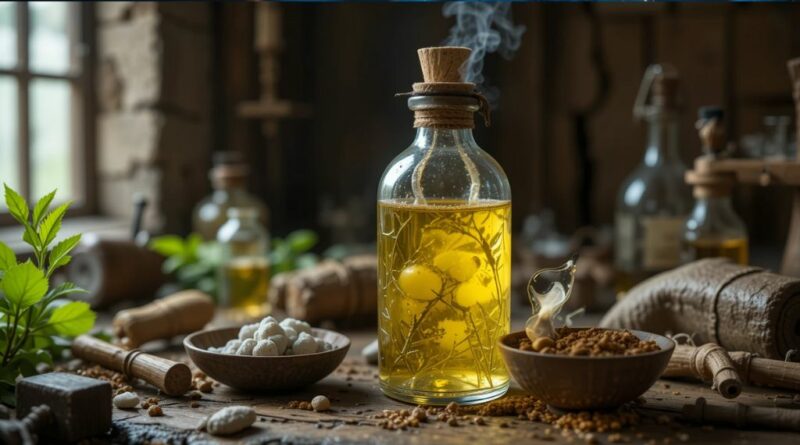
The Medieval Remedy That Intrigued Scientists
In the realm of medical science, antibiotic resistance poses a sustained challenge. However, researchers have found a possible unlikely ally in the fight against superbugs: a thousand-year-old recipe from medieval England that, in laboratory and mouse experiments, killed MRSA with activity comparable to a standard antibiotic. It has not been tested in people and is not a treatment.
The Discovery
Deep within the British Library’s collection lies a manuscript that has captured the attention of microbiologists worldwide. Bald’s Leechbook, a 10th-century Anglo-Saxon medical text, contains a recipe that researchers at the University of Nottingham reported could kill up to 90% of MRSA, an antibiotic-resistant bacterium, in infected wound samples from mice.
The remedy, known as “Bald’s eye salve,” was found in laboratory tests to kill the modern superbug MRSA, which suggests that medieval physicians may have had some effective remedies, although whether they understood why is another matter.
The Ancient Recipe and What Science Has Found
The ingredients of Bald’s eye salve read like a medieval shopping list: garlic, onion (or another allium), wine, and bovine bile. These everyday components must be crushed together and left to stand for nine days in a bronze vessel before use. The researchers found that the individual ingredients had little effect on their own; only the complete, reconstructed mixture showed strong antibacterial activity.
In the mouse experiments, Bald’s eye salve killed up to 90% of MRSA bacteria in wound biopsies. The authors found that the effect came not from a single ingredient but from the combination, and said its activity was comparable to vancomycin, a standard antibiotic used against MRSA. It is not accurate to say that the salve works better than modern antibiotics.
The medieval text describes the remedy as a treatment for a “wen”—a cyst or lump in the eye—but modern testing has revealed antibacterial activity. The salve also acted against biofilms, dense bacterial colonies that form protective barriers and are difficult to treat with conventional antibiotics.
The Science Behind the Ancient Wisdom
The research, published in the journal mBio, came from a collaboration between medieval scholars and microbiologists. The team followed the original Anglo-Saxon instructions as closely as they could, including a metal vessel and the nine-day brewing period.
It is intriguing that the effect depends on the combination, a principle modern medicine also uses. While individual components like garlic have known antimicrobial properties, the complete mixture was far more effective than any single ingredient in these tests.
The University of Warwick has also reported research suggesting that medieval medicine remedies could provide leads for new treatments for modern infections, with the salve showing activity in lab tests against several bacteria that cause biofilm infections.
A Growing Crisis
Antimicrobial resistance (AMR) is one of the most pressing health challenges of our time. A 2024 study published in The Lancet forecast that around 39 million people could die from antibiotic-resistant infections between 2025 and 2050, with annual deaths directly attributable to resistance reaching 1.91 million by 2050 if nothing changes.
The World Health Organisation has identified AMR as one of the top ten global public health threats. In this context, research into unusual sources of antibacterial compounds, including old medical texts, is more than academic curiosity, although it is a long way from a clinical treatment.
The Broader Implications for Medical Research
The Bald’s eye salve results have encouraged some researchers to look at historical medical texts as potential sources of leads for new treatments. Medieval physicians, working without modern laboratory equipment, developed treatments through careful observation and experimentation over generations. Their empirical approach may occasionally have identified effective combinations, though many historical remedies do not work.
This research also highlights the importance of preserving and studying historical medical knowledge. The British Library’s digitisation efforts have made manuscripts like Bald’s Leechbook accessible to researchers worldwide, enabling discoveries that might otherwise remain hidden in ancient texts.
Challenges and Future Directions
While the results are interesting, significant challenges remain, and there have been no human trials. Researchers must identify the specific mechanisms that make the combination effective, standardise production methods, and conduct extensive clinical trials to ensure safety and efficacy in humans. Readers should not try to make or use this remedy: bovine bile and raw ingredients in the eye or on wounds could cause harm.
The complexity of recreating the exact conditions described in the medieval text—from the bronze vessel to the precise timing—presents manufacturing challenges that must be overcome. Additionally, regulatory frameworks for approving treatments based on historical remedies are still evolving.
Learning from the Past to Secure the Future
The story of Bald’s eye salve demonstrates that innovation doesn’t always mean starting from scratch. Sometimes useful leads come from looking backwards and applying modern scientific methods to ancient knowledge.
As we face the growing threat of antibiotic resistance, this medieval remedy reminds us that useful leads may be waiting in the pages of history. The collaboration between medievalists and microbiologists suggests that interdisciplinary approaches—combining historical scholarship with cutting-edge science—may be key to solving some of our most pressing medical challenges.
The humble ingredients in Bald’s eye salve—garlic, onion, wine, and bile—are a reminder that promising leads can come from simple sources. Whether this thousand-year-old recipe ever leads to a treatment depends on research that has yet to be done.
We’d like to hear your questions or comments on today’s topic!
For more articles like this one, click here.
Thought for the day:
“Self-preservation is the first law of nature.” Samuel Butler