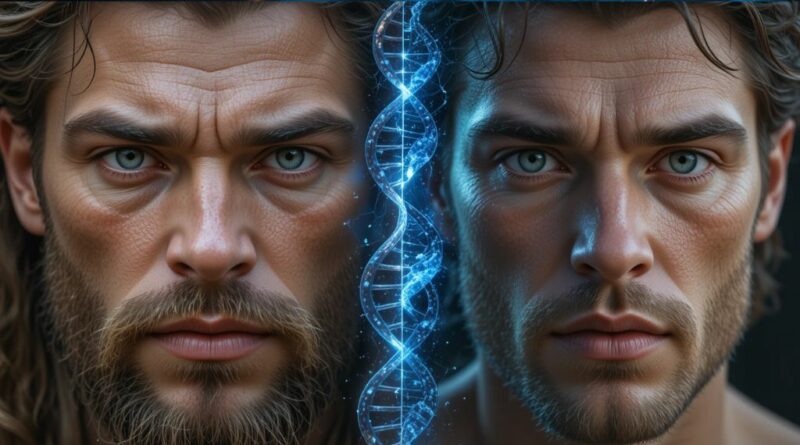
The Teacher from Somerset and His 9,100-Year Old Ancestor
In the quiet village of Cheddar, Somerset, where limestone cliffs rise dramatically from pastoral English countryside, history isn’t just buried beneath the ground—it walks the streets, teaches in classrooms, and goes home for tea each evening.
This remarkable story dates from 1997, when Adrian Targett, a history teacher at Kings of Wessex Community School, was found to share a maternal DNA lineage (mitochondrial haplogroup U5) with Cheddar Man, Britain’s most famous ancient resident, whose roughly 9,000-year-old remains were found in nearby Gough’s Cave in 1903.
A Surprising DNA Match
The DNA link between Targett and Cheddar Man is recorded by Guinness World Records as the farthest traced descendant by DNA, spanning some 300 generations. It was established through mitochondrial DNA analysis, which traces maternal lineage. Mitochondrial DNA passes from mother to child, so a match indicates a shared maternal ancestor, although it does not trace a single named line of descent across the intervening millennia.
The result emerged during the filming of a television documentary for HTV, with the work led by Oxford geneticist Bryan Sykes. “I am overwhelmed, a bit surprised,” Targett said at the time. Note that this was news from 1997, and techniques have moved on a great deal since.
Geography adds to the appeal of the story. Targett lives just half a mile from where Cheddar Man’s skeleton was discovered. However, a shared haplogroup does not show that a particular family stayed in the area for nine thousand years; many people across Europe share haplogroup U5, and populations moved in and out of Britain over that time.
Cheddar Man: Portrait of Britain’s Ancient Past
Cheddar Man is the oldest nearly complete human skeleton found in Britain, radiocarbon dated to approximately 7150 BC (so about 9,000 years old, though he is often described as around 10,000 years old). He lived during the Mesolithic period, when Britain was still connected to continental Europe by a land bridge called Doggerland, and when hunter-gatherer communities roamed landscapes vastly different from today’s manicured countryside.
For over a century after his discovery, scientists could only speculate about Cheddar Man’s appearance. However, advances in ancient DNA analysis have since allowed a reconstruction of his appearance. According to the 2018 analysis, Cheddar Man most likely had dark to black skin, blue eyes and dark curly hair when he lived in what is now southwest England about 10,000 years ago, though pigmentation predicted from DNA carries some uncertainty.
This genetic portrait, revealed through collaboration between University College London and the Natural History Museum, changed how many people imagine ancient Britons. Cheddar Man had genetic variants associated with dark skin pigmentation, consistent with other Mesolithic remains found in Europe.
The striking combination of dark skin and blue eyes reflects a population that had not yet developed the genetic adaptations for lighter skin pigmentation that would later become common in northern European populations. Paler skin lets more UV light in, which helps the body make vitamin D in climates with less sunlight, and lighter skin became common in northern Europe later, after Cheddar Man’s time.
The Science Behind the Connection
The genetic analysis that linked Cheddar Man to Adrian Targett focused on mitochondrial DNA haplogroup U5. Both Cheddar Man and Targett belong to mitochondrial DNA haplogroup U5, indicating a shared maternal lineage. Research shows that U5 was the main haplogroup of Mesolithic European hunter gatherers, present at 83% in European hunter gatherers before the influx of Middle Eastern farmers. This shared haplogroup demonstrates a common maternal ancestor in the distant past, and haplogroup U5 is carried by many people in Europe today, so Targett is one of many people who could share this ancient connection.
DNA was discovered in the pulp cavity of one of Cheddar Man’s molars and tested at the Institute of Molecular Medicine at Oxford University. Teeth are among the best sources of ancient DNA, as the hard enamel protects the pulp cavity inside.
The mitochondrial DNA analysis revealed not just the connection to modern populations, but also insights into ancient migration patterns and the genetic diversity of early European populations. Recent studies support hypotheses that haplogroup U5 mtDNAs expanded throughout Northern, Southern and Central Europe with more recent expansions into Western Europe and Africa. Ancient DNA techniques have since become standard practice in archaeological genetics, opening new windows into human prehistory.
A Window Into Mesolithic Life
Cheddar Man’s world was one of dramatic environmental change and human adaptation. He lived during a period when Britain’s landscape was transforming as the last Ice Age ended and sea levels rose. The Somerset Levels, now drained agricultural land, were then vast wetlands teeming with wildlife.
His community would have been small, likely consisting of extended family groups that moved seasonally to exploit different resources. They crafted sophisticated stone tools, including flint axes for felling trees and adzes for working wood, as well as a variety of smaller flint tools and microlithic implements that were mounted as points or barbs in arrows and harpoons. These Mesolithic hunter-gatherers hunted deer and wild boar, gathered nuts and berries, and probably had intricate knowledge of their local environment that far exceeded anything we might possess today.
The caves of Cheddar Gorge provided shelter and may have held spiritual significance. Archaeological evidence suggests these caves were used intermittently over thousands of years, creating layers of human occupation that tell the story of Britain’s earliest inhabitants.
Modern Implications of Ancient Connections
The link between Cheddar Man and Adrian Targett prompts reflection on human migration and settlement patterns. In an age of global mobility, it is striking that a modern person in the same village shares a maternal lineage with someone who lived there about 9,000 years ago, though that does not mean the family stayed put.
This discovery has implications beyond mere curiosity. It demonstrates the power of modern genetic techniques to illuminate human history. It also reflects how some locations have held enduring appeal for human habitation across millennia.
For Adrian Targett, the revelation transformed his understanding of his own place in history. As a history teacher, he had spent years educating students about the past—never knowing that he carried within his cells the genetic memory of Britain’s ancient inhabitants.
The Broader Context of Ancient DNA Research
The Cheddar Man-Targett connection represents just one example of how ancient DNA research is transforming our understanding of human prehistory. Similar studies across Europe have revealed complex patterns of migration, genetic diversity, and population replacement that challenge traditional archaeological narratives.
Recent advances in DNA extraction and analysis techniques have made it possible to obtain genetic information from increasingly ancient and degraded remains. These methods are providing unprecedented insights into everything from ancient diseases and diets to migration routes and population genetics.
The field of archaeogenetics continues to evolve rapidly, with new discoveries regularly reshaping our understanding of human history. Each ancient genome sequenced adds another piece to the complex puzzle of human evolution and migration.
Living History
Part of the appeal of the Cheddar Man story is what it says about history itself. We often think of the past as distant and disconnected from our daily lives, something that exists only in museums and textbooks. Yet here, in the person of Adrian Targett, we see a link to the deep past carried forward through the molecular machinery of inheritance.
The story resonates because it makes the abstract concept of deep time tangible and personal. It reminds us that we are all part of a chain of ancestry stretching back to the dawn of human existence.
In classrooms across Britain, Adrian Targett continues to teach history, though now with the unique perspective of someone who doesn’t just know about the past—he shares a maternal lineage with a man from 9,000 years ago. His story stands as a testament to the enduring connections that bind us to our ancestors and to the landscapes they called home.
The caves of Cheddar Gorge continue to attract visitors from around the world, drawn by the dramatic limestone formations and the rich archaeological heritage they contain. But now they hold an additional significance as the find-spot of Britain’s most famous ancient skeleton.
In an age of constant change and global mobility, the story of Cheddar Man and Adrian Targett offers a profound reminder of the deep roots that connect us to place, to family, and to the ancient currents of human history that flow through our genes and across our landscapes, linking past and present in ways we are only beginning to understand.
We’d like to hear your questions or comments on today’s topic!
For more articles like this one, click here.
Thought for the day:
“If you change the way you look at things, the things you look at change.” Wayne Dyer