How DTLS-SRTP Keeps WebRTC Voice and Video Secure
When you make a browser-based call or join an online meeting, you probably don’t give much thought to how your audio and video stay private. Yet behind every WebRTC session is a mandatory encryption framework designed to stop third parties intercepting or tampering with your media.
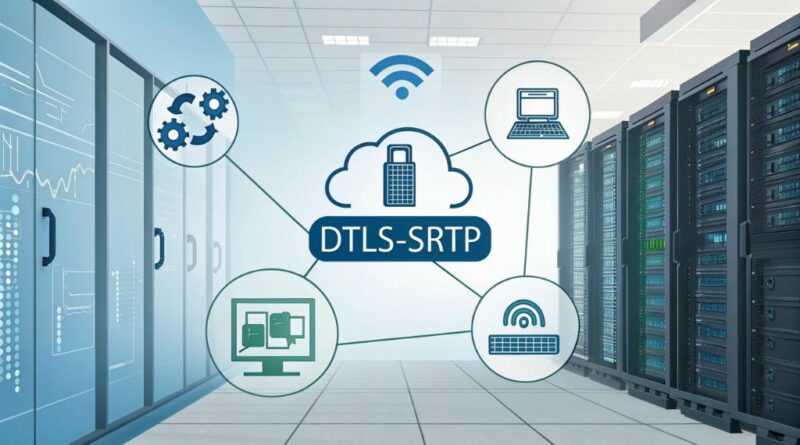
That framework is called DTLS-SRTP — a combination of protocols that secure the media in every WebRTC session.
In this article, we’ll explore what DTLS-SRTP is, how it works, and why it’s critical to keeping VoIP and WebRTC secure.
The Basics: Why Encryption Matters in WebRTC
WebRTC (Web Real-Time Communication) enables browsers and mobile apps to share audio, video, and data streams without installing extra software.
But because WebRTC operates across the open internet, encryption is non-negotiable. Every packet of voice or video could otherwise be exposed to attackers, service providers, or even compromised routers along the way.
👉 IETF RFC 8827 – WebRTC Security Architecture
That’s where DTLS-SRTP (Datagram Transport Layer Security for Secure Real-time Transport Protocol) comes in — it protects WebRTC traffic from eavesdropping and tampering.
Breaking Down DTLS-SRTP
DTLS-SRTP is not a single technology, but a combination of two complementary standards:
- DTLS (Datagram Transport Layer Security) – performs the handshake between peers and derives the encryption keys, authenticating each side by certificate fingerprint.
- SRTP (Secure Real-Time Transport Protocol) – encrypts the actual voice and video packets once the connection is established.
The pairing allows WebRTC to exchange encryption keys securely and protect every subsequent media frame.
👉 IETF RFC 5764 – DTLS-SRTP Specification
How It Works in a Typical WebRTC Session
When you start a WebRTC call, your browser and the peer device perform a DTLS handshake.
- Handshake Initiation – Each peer generates encryption keys.
- Certificate Exchange – Each side presents a certificate (self-signed ones are normal), and its fingerprint is checked against the one received in signalling, so the signalling channel must itself be trusted.
- SRTP Session Setup – Once authenticated, DTLS hands the keys to SRTP, which encrypts the voice and video streams.
From that point forward, all communication occurs through encrypted SRTP packets, which prevents anyone on the network path from reading or modifying the media without the keys.
The Advantages of DTLS-SRTP
1. Encryption Independent of Relays
Media is encrypted between the two DTLS endpoints, so plain relay nodes such as TURN servers cannot decrypt it. Servers that terminate DTLS, such as gateways, media servers and conferencing bridges, do see the media.
2. No Pre-Shared Keys
Unlike SDES, an older VoIP approach that sends SRTP keys inside the signalling messages, DTLS-SRTP negotiates fresh keys for each session directly between the endpoints, so keys are not exposed to the signalling path.
3. Built for the Web
Because DTLS runs over UDP (unlike traditional TLS, which runs over TCP), it avoids TCP head-of-line blocking, which suits low-latency voice and video.
👉 Mozilla Developer Docs – RTP Glossary
DTLS-SRTP in VoIP and PBX Ecosystems
DTLS-SRTP isn’t exclusive to WebRTC — it’s also supported by modern VoIP and PBX systems that need encrypted media transport.
For example:
- Asterisk and FreeSWITCH both include DTLS-SRTP support for WebRTC endpoints.
- Many cloud PBX providers use it to secure browser-based softphones.
Support for it is now a common requirement for providers that offer browser-based calling.
👉 Asterisk Documentation – Configuring Asterisk for WebRTC Clients
How It Compares to Traditional SIP Encryption
Traditional SIP systems often relied on TLS + SRTP, where TLS encrypted only the SIP signalling and SRTP handled the media.
WebRTC’s use of DTLS-SRTP replaces the separate SRTP key exchange: keys are negotiated in-band over the media path rather than carried in the signalling. Signalling is still required to set up the call, and in WebRTC it is typically protected with TLS (HTTPS/WSS).
Common Challenges in Deployment
DTLS-SRTP is well regarded, but implementing it correctly can be tricky:
- Certificate Validation: Some systems skip verification, creating potential weaknesses.
- NAT Traversal: When peers are behind firewalls, extra care must be taken to maintain key exchange integrity via ICE.
- Interoperability: Older SIP devices without DTLS support need a gateway to translate between SDES-SRTP (or plain RTP) and DTLS-SRTP.
Open-source tools such as Janus Gateway, and SIP proxies like OpenSIPS and Kamailio (paired with a media relay), can handle this bridging.
The Future: Post-Quantum and Advanced Encryption
With cyber threats constantly evolving, standards bodies are working on post-quantum and hybrid key exchange for TLS and DTLS. Such algorithms could eventually protect WebRTC sessions against future quantum attacks, but support in WebRTC stacks is still at an early stage.
Browsers also continue to update the TLS and DTLS versions and cipher suites they accept.
Conclusion
DTLS-SRTP might not be something most users ever think about, but it is a core reason WebRTC media is encrypted by default.
It runs invisibly in every WebRTC session, keeping voice and video confidential from anyone on the network path.
As remote collaboration, browser softphones, and cloud PBX systems continue to expand, DTLS-SRTP is likely to remain central to securing real-time media.
For more articles like this, visit SoftpageCMS.
Related: how safe WebRTC browser calls are.